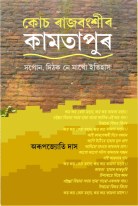
 Koch Rajbanshir Kamatapur: Xopon, Dithok ne Matho Itihas by Arup Jyoti Das, Guwahati, Assam, Blue Sparrow Books, 2015, 176 pp, ISBN: 9781630417505, INR 395/-
Marami Bhakat: Northeast India is much known to the world for its various movements for social justice triggered by ethnic identity. These movements have often demanded recognition of historical region and homelands. Kamatapur Movement is one such movement, which seeks recognition of a historical region called Kamatapur in the form of a state (federal unit) in modern India comprising areas of North Bengal and Assam. This movement is mostly spearheaded by Koch Rajbanshi people of Assam and West Bengal. In this book author Das has taken up this social issue of the Koch Rajbanshis, which has been mostly ignored by the current academic discourse. Das is very much aware of trans-border nature of the movement, its historical complexities and current political narratives.
The book is largely divided into three sections. Thefirst section deals particularly with Kamatapur Movement with its historical background. This section has eight chapter devoted various issues like historical background, social mobility of the Rajbanshis and many more. The 2nd section is collection of articles on recent political challenges of Kamatapur area and political crossing of various ethno politics of confronting groups. The 3rd section of the book contains another set of articles which are related to Koch Rajbanshi, but not directly to the Kamatapur Movement.
The Introductory chapter of the book gives us an outline of the whole Kamatapur Movement and has successfully discussed the various stages and layers of the movement. The chapter has discussed the rise of the armed struggle of Kamatapur Liberation Organization and role of various civil society organizations and students bodies which are involved in this movement for self- determination of the Koch Rajbanshis. The writer argues in this chapter that the aspiration of the Koch Rajbanshi for a homeland is much old and it has its roots in the annexation of Cooch Behar State with West Bengal as a district.
The 2nd chapter is about the Koch Rajbanshi people, their origin and migration theories. Here, Das has tried to look into the complexities of Koch Rajbanshi identity, its ethnic affiliation and the issues of transformation of the tribe to caste society. Das argues that Koch Rajbanshi people has the right to claim themselves as Kamatapuri, since they have been the main component of both ruler and ruled in the area for seven hundred years. Das has interpreted colonial texts, various legends and other local sources while framing his observation on the identity formation of the Koch Rajbanshi people. In his observation, Das says that Koch Rajbanshi is a “social category” rather than a hard bound ethnic identity.
The 3rd chapter analyses the historical background of the Kamatapur region, which comprises present Northern part of West Bengal and lower Assam. The chapter starts with the history of Kamatapur of the middle of the 13th century and ends with emergence of colonial Cooch Behar in 1771. This chapter is mostly confined with the history of present North Bengal and has not discussed the history of the Koch Rajbanshi of present Assam. In this chapter, Das has given a vivid description of Kamatapur kingdom from the pre-Koch period, emergence of Koch dynasty in Kamatapur and transition of Kamatapur into Cooch Behar Princely state.
The fourth chapter deals with the history of the Kamatapur of western side. Kamatapur was divided between the Koch royal families in the end of the 16th century as Koch Kamata and Koch-Hajo. The Koch Hajo region became part of modern Assam after independence of India. This chapter provides a valuable account of the history of Western Assam and lower Assam which was under the Koches till independence. Though brief, the author has given strong account of small Koch kingdoms and estates like Bijni, Gauripur, Darrang and Beltola. The discussion on the Beltola kingdom might be 1st of its kind for which Das should be given credit. This chapter gives the reader a clue why Kamatapur is demanded in Assam besides West Bengal.
The next chapter deals with the complexities and politics of merger of Cooch Behar Princely State into the Indian domain and then its annexation with West Bengal as a mere modern Indian district. The lost of the identity of the Kamatapur (Cooch Behar) region in Independent India has been argued as one of the root causes of demand for Kamatapur in present time. The author has mainly interpreted correspondence between Sardar Vallabbhai Patel and B.C. Roy to look into the politics of annexation of Cooch Behar with West Bengal. This chapter could have been deeper in investigating the issue.
The 6th chapter discusses the upward mobility movement of the Rajbanshis in the early 20th century which laid the foundation for a social justice movement in the later period. The chapter discusses how local Rajbanshis were alienated by migrant upper caste gentry who came from East Bengal and how power structure and land holding changes due to the same. This is an important chapter in terms of understanding the social causes which has resulted the present movement.
In the subsequent chapter, Das has discussed the language of the Koch Rajbanshis which is known as Kamatapuri, Rajbanshi or Goalparia. Das has avoided linguistic complexities while discussing language of the Koch Rajbanshis and mainly focused on the politics of recognition of the language. The next, chapter which is the last chapter of the 1st section, is the concluding chapter.
This book is a must read for those who wants to understand Koch Rajbanshi peoples’ aspiration for social justice. Das being a member of the Koch Rajbanshi community has found it difficult sometimes to disassociate himself from the sentiment of the Kamatapur Movement (as well as with the Koch Rajbanshi), particularly in the last section of the book, where he has written on various topics related to Koch Rajbanshis. Except this exception, Das has successfully played the role of both insider and outsider as a writer.
(Marami Bhakat is a Ph D Scholar at Dept. Political Science , Gauhati University)
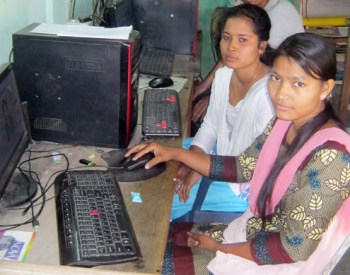 In order to bring about positive change among the traditional Koch-Rajbanshi people, including other marginalized community members, CKRSD has initiated computer education and skill development programs in rural areas by supporting local entrepreneurs to set-up home-based Computer Centre’s and also establishing CKRSD’s own Computer Study Center with the support of local stakeholders. Through such Computer and Study Centre’s, CKRSD and its collaborating partners aim to provide free as well as low cost computer education to students and job seekers coming from marginalized section of the society. Even Computer Training camps are held to give basic computer training to women and school going children. At present a computer study center has been established in Gauripur and a computer institute is being supported in Futkibari, in the border district of Dhubri in Assam.
 Centre for Koch (Rajbanshi) Studies and Development